 Codon Chart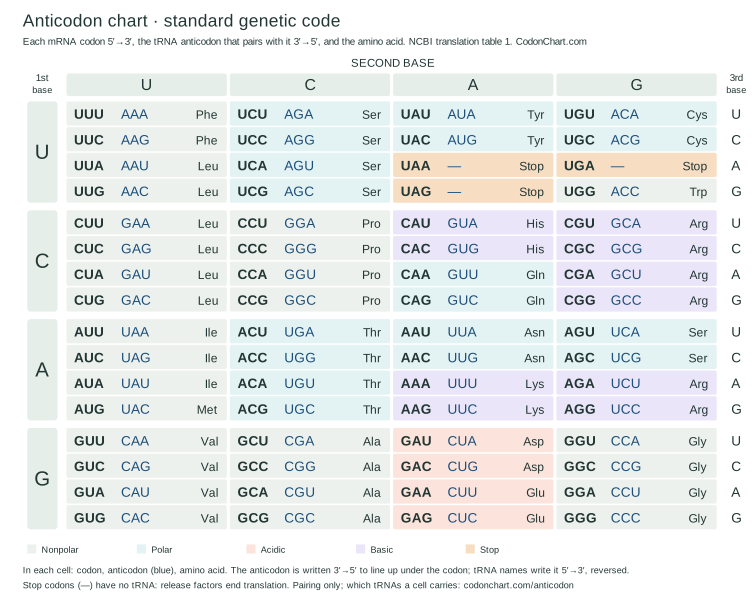
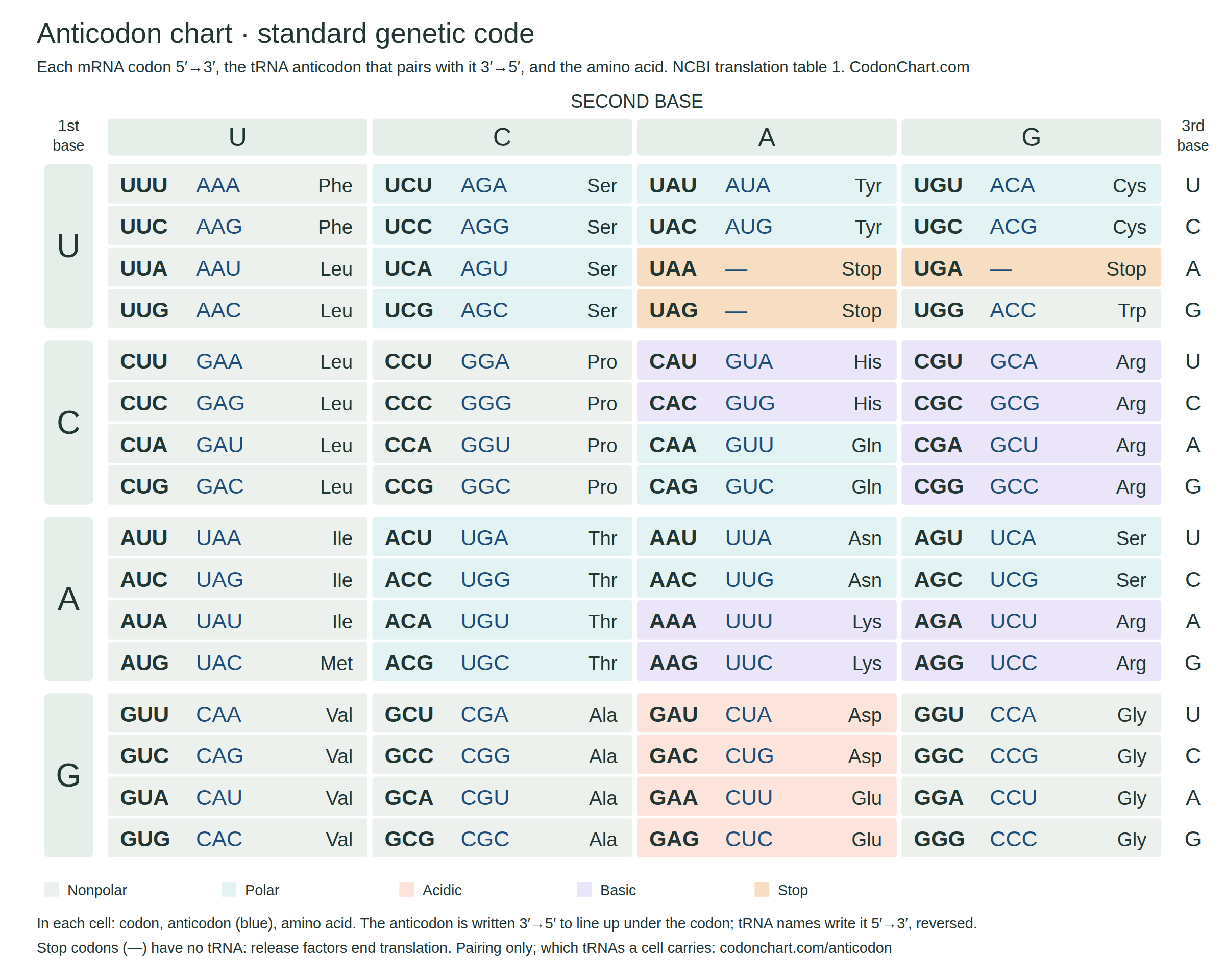
What an anticodon is
An anticodon is the sequence of three bases in a transfer RNA (tRNA) that pairs with a codon of messenger RNA (mRNA) during translation. Each tRNA carries the amino acid that matches its anticodon, so when the anticodon pairs with a codon on the ribosome, that amino acid joins the growing protein (NHGRI, OpenStax Biology 2e).
Paste codons, an mRNA or the coding strand of a gene, and select Find. The finder lists each codon with its anticodon written both ways, the amino acid, and the number of tRNA genes with that anticodon in human cells, from GtRNAdb’s high-confidence set, and in E. coli. The example is the trp leader peptide of E. coli, read from its AUG start codon to its UGA stop: 14 anticodons and a stop codon.
Codon vs anticodon
| Codon | Anticodon | |
|---|---|---|
| Found in | mRNA | tRNA |
| Written | 5′ to 3′, the direction the ribosome reads | 3′ to 5′ when aligned under the codon; 5′ to 3′ in tRNA names |
| How many | 64: 61 for amino acids and 3 stop codons | Fewer than 61: human tRNA genes carry 46 different anticodons, E. coli’s 39 |
| Methionine | 5′-AUG-3′ | 3′-UAC-5′, written 5′-CAU-3′ |
A codon chart lists codons, not anticodons. To find the amino acid a tRNA carries, turn its anticodon back into the codon it pairs with, then look that codon up in the codon chart.
How to find the anticodon of a codon
- Write the mRNA codon 5′ to 3′. From the coding strand of DNA, replace T with U: ATG becomes AUG.
- Pair each base: A with U, U with A, G with C and C with G. AUG gives UAC.
- The anticodon runs the other way, so it reads 3′ to 5′ under the codon: 5′-AUG-3′ pairs with 3′-UAC-5′.
- To write it 5′ to 3′, as tRNA genes and databases name it, reverse it: 5′-CAU-3′.
Written 3′ to 5′, the anticodons have the same bases as the DNA template strand, with U in place of T, because both pair with the mRNA. For a template strand, DNA to mRNA gives the mRNA, its anticodons and amino acids in one worksheet.
Anticodon chart
Every codon of the standard genetic code, grouped by amino acid, with its anticodon written both ways. The last two columns count the tRNA genes with that exact anticodon in human cells and in E. coli; where there are none, they name the tRNA that reads the codon instead.
| Codon 5′→3′ | Anticodon 3′→5′ | Anticodon 5′→3′ | Human tRNA genes | E. coli tRNA genes |
|---|---|---|---|---|
| Alanine · Ala · A | ||||
GCU | CGA | AGC | 26 | 0wobble: GGC (2) |
GCC | CGG | GGC | 0inosine: IGC (26) | 2 |
GCA | CGU | UGC | 8 | 3 |
GCG | CGC | CGC | 4 | 0wobble: UGC (3) |
| Arginine · Arg · R | ||||
CGU | GCA | ACG | 7 | 4 |
CGC | GCG | GCG | 0inosine: ICG (7) | 0inosine: ICG (4) |
CGA | GCU | UCG | 6 | 0inosine: ICG (4) |
CGG | GCC | CCG | 4 | 1 |
AGA | UCU | UCU | 6 | 1 |
AGG | UCC | CCU | 5 | 1 |
| Asparagine · Asn · N | ||||
AAU | UUA | AUU | 0wobble: GUU (25) | 0wobble: GUU (4) |
AAC | UUG | GUU | 25 | 4 |
| Aspartic acid · Asp · D | ||||
GAU | CUA | AUC | 0wobble: GUC (13) | 0wobble: GUC (3) |
GAC | CUG | GUC | 13 | 3 |
| Cysteine · Cys · C | ||||
UGU | ACA | ACA | 0wobble: GCA (29) | 0wobble: GCA (1) |
UGC | ACG | GCA | 29 | 1 |
| Glutamic acid · Glu · E | ||||
GAA | CUU | UUC | 8 | 4 |
GAG | CUC | CUC | 8 | 0wobble: UUC (4) |
| Glutamine · Gln · Q | ||||
CAA | GUU | UUG | 6 | 2 |
CAG | GUC | CUG | 13 | 2 |
| Glycine · Gly · G | ||||
GGU | CCA | ACC | 0wobble: GCC (14) | 0wobble: GCC (4) |
GGC | CCG | GCC | 14 | 4 |
GGA | CCU | UCC | 9 | 1 |
GGG | CCC | CCC | 5 | 1 |
| Histidine · His · H | ||||
CAU | GUA | AUG | 0wobble: GUG (9) | 0wobble: GUG (1) |
CAC | GUG | GUG | 9 | 1 |
| Isoleucine · Ile · I | ||||
AUU | UAA | AAU | 15 | 0wobble: GAU (3) |
AUC | UAG | GAU | 3 | 3 |
AUA | UAU | UAU | 5 | 0lysidine: LAU (2) |
| Leucine · Leu · L | ||||
UUA | AAU | UAA | 4 | 1 |
UUG | AAC | CAA | 6 | 1 |
CUU | GAA | AAG | 9 | 0wobble: GAG (1) |
CUC | GAG | GAG | 0inosine: IAG (9) | 1 |
CUA | GAU | UAG | 3 | 1 |
CUG | GAC | CAG | 9 | 4 |
| Lysine · Lys · K | ||||
AAA | UUU | UUU | 12 | 6 |
AAG | UUC | CUU | 15 | 0wobble: UUU (6) |
| Methionine · Met · M | ||||
AUG | UAC | CAU | 20 | 6 |
| Phenylalanine · Phe · F | ||||
UUU | AAA | AAA | 0wobble: GAA (10) | 0wobble: GAA (2) |
UUC | AAG | GAA | 10 | 2 |
| Proline · Pro · P | ||||
CCU | GGA | AGG | 9 | 0wobble: GGG (1) |
CCC | GGG | GGG | 0inosine: IGG (9) | 1 |
CCA | GGU | UGG | 7 | 1 |
CCG | GGC | CGG | 4 | 1 |
| Serine · Ser · S | ||||
UCU | AGA | AGA | 9 | 0wobble: GGA (2) |
UCC | AGG | GGA | 0inosine: IGA (9) | 2 |
UCA | AGU | UGA | 4 | 1 |
UCG | AGC | CGA | 4 | 1 |
AGU | UCA | ACU | 0wobble: GCU (8) | 0wobble: GCU (1) |
AGC | UCG | GCU | 8 | 1 |
| Threonine · Thr · T | ||||
ACU | UGA | AGU | 9 | 0wobble: GGU (2) |
ACC | UGG | GGU | 0inosine: IGU (9) | 2 |
ACA | UGU | UGU | 6 | 1 |
ACG | UGC | CGU | 5 | 1 |
| Tryptophan · Trp · W | ||||
UGG | ACC | CCA | 7 | 1 |
| Tyrosine · Tyr · Y | ||||
UAU | AUA | AUA | 0wobble: GUA (13) | 0wobble: GUA (3) |
UAC | AUG | GUA | 13 | 3 |
| Valine · Val · V | ||||
GUU | CAA | AAC | 9 | 0wobble: GAC (2) |
GUC | CAG | GAC | 0inosine: IAC (9) | 2 |
GUA | CAU | UAC | 5 | 5 |
GUG | CAC | CAC | 13 | 0wobble: UAC (5) |
| Stop codons | ||||
UAA | — | — | none | none |
UAG | — | — | none | none |
UGA | — | — | noneselenocysteine: UCA (1) | noneselenocysteine: UCA (1) |
Wobble: a G·U or U·G pair at the codon’s third base. I: inosine, made from the A a tRNA gene encodes. L: lysidine, made from C in E. coli’s tRNA-Ile2. Human genes from GtRNAdb (high-confidence set, GRCh38); E. coli genes from NCBI RefSeq NC_000913.3; assignments from NCBI table 1.
Stop codons have no anticodon
No tRNA reads UAA, UAG or UGA in the standard code: proteins called release factors recognize a stop codon and end translation (OpenStax Biology 2e). Neither GtRNAdb’s high-confidence human set nor E. coli’s annotated genes include a tRNA with an anticodon for UAA or UAG.
UGA has one exception. Both cells carry a selenocysteine tRNA gene with anticodon UCA, which inserts the amino acid selenocysteine at particular UGA codons of selenoprotein mRNAs. It needs a signal in the mRNA called a SECIS element; elsewhere, UGA is a stop (Labunskyy and colleagues, 2014).
Wobble: one tRNA, several codons
A codon’s first two bases pair strictly with the anticodon, but its third base pairs more loosely with the anticodon’s first base, position 34 of the tRNA. Francis Crick called this wobble (Crick, 1966):
| Anticodon’s first base | Pairs with the codon’s third base |
|---|---|
| C | G |
| A | U |
| G | C or U |
| U | A or G |
| I (inosine) | U, C or A |
So a cell needs fewer anticodons than codons. Fifteen codons have no human tRNA gene with the exact partner anticodon, and 22 have none in E. coli. Each is read by a tRNA that pairs with it through wobble; the finder and the chart name it.
Inosine and lysidine
Some tRNAs carry a modified base at the wobble position. In human cells, tRNAs whose genes encode an anticodon beginning with A, those for alanine, arginine, isoleucine, leucine, proline, serine, threonine and valine, have that A changed to inosine (I), which pairs with U, C or A (Torres and colleagues, 2015). The high-confidence human set has no gene with anticodon GGC, for example: alanine’s GCC codon is read by tRNA-Ala genes with anticodon AGC, which the tRNA carries as IGC.
In E. coli, the only tRNA with inosine is tRNA-Arg2, anticodon ACG (Wolf and colleagues, 2002). E. coli’s tRNA-Ile2 genes encode CAU, the methionine anticodon; a modified C called lysidine makes the tRNA read AUA, an isoleucine codon, instead of AUG (Muramatsu and colleagues, 1988).
The finder applies Crick’s rules with these modifications. Other modified bases widen pairing further: in Salmonella, a close relative of E. coli, a tRNA-Pro with a modified U reads all four proline codons (Näsvall and colleagues, 2004). So a codon can be read by more tRNAs than the finder lists.
tRNA genes in human and E. coli cells
GtRNAdb’s high-confidence set lists 429 tRNA genes in the human reference genome: 428 for the 20 amino acids, 9 of them for the initiator tRNA that starts proteins at AUG, and one for selenocysteine (Chan and Lowe, 2016). NCBI’s record of E. coli K-12 MG1655 annotates 86: 85 for the amino acids, 4 of them initiators, and one for selenocysteine.
Many anticodons have several gene copies: 26 human genes encode tRNA-Ala with anticodon AGC. A gene count is not the amount of each tRNA in a cell, which also depends on which genes are expressed.
Sources: Crick (1966); Torres and colleagues (2015); Wolf and colleagues (2002); Muramatsu and colleagues (1988); human tRNA genes from GtRNAdb (Data Release 22), E. coli tRNA genes from NCBI’s RefSeq record NC_000913.3. See sources and methods.